
TV Mounting Studio Irvine: TV Wall Mounting in Irvine
TV Mounting Studio Irvine covers standard TV wall mounting across Irvine — fixed and tilting mounts in detached homes, townhomes, condos and apartments — where the installer identifies whether the wall is framed in wood or steel, anchors to match, sets the screen height for the room's seating and leaves the cables neat.
Bookings aren't open yet. Leave your name and number; your message is recorded, and you'll get one message when a local installer is available.
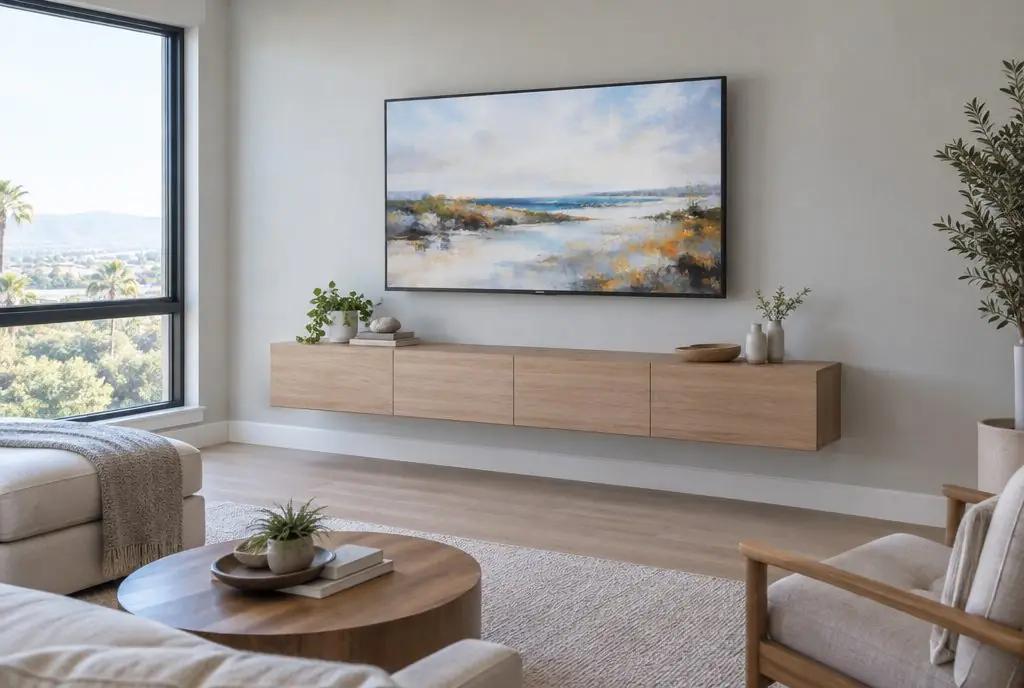 Illustration
Reading the wall before drilling
The first five minutes of an Irvine install decide the rest: a stud finder with metal detection, a small probe hole behind where the plate will go, and a look at whether the wall is shared with a neighbor. A detached home in Northwood or Turtle Rock is almost always wood studs at 16 inches. A condo near the Spectrum or a podium building on Jamboree is often steel. A townhome's living-room wall may be the party wall with the unit next door.
| What the installer finds | Typical Irvine setting | Anchoring |
|---|---|---|
| Wood studs at 16 in | Detached homes in most villages | 5/16 in lag bolts, two studs |
| Steel studs | Condo and podium buildings | Rated toggles through the stud, or a backer plate |
| Shared party wall | Townhomes and condos | Moved to an interior partition where possible |
| Builder media box | New Great Park and Portola Springs homes | Mount centered on the box, studs either side |
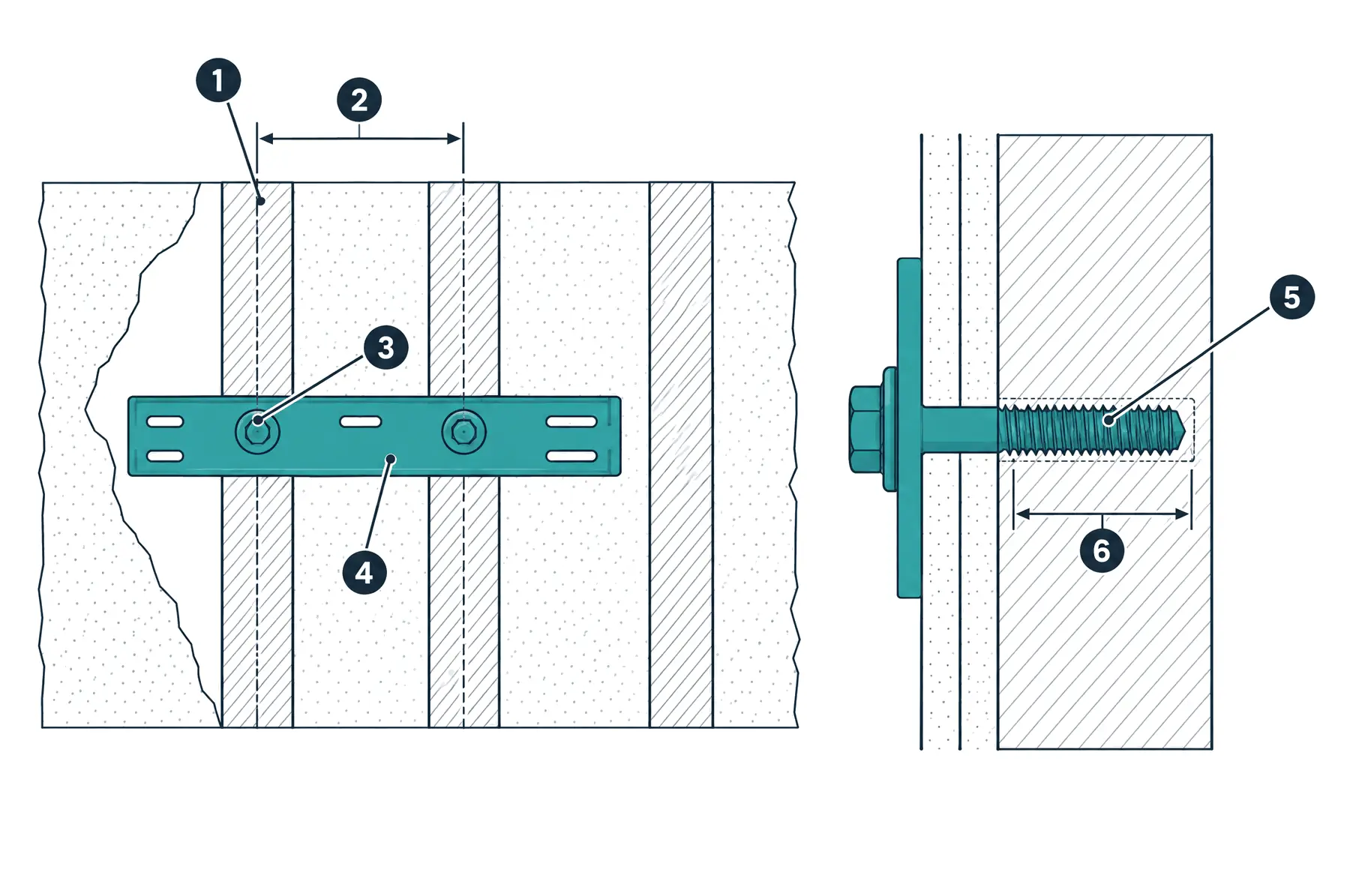
What the numbers show
- Stud centre line Each bolt goes on the centre line of a stud, found with a stud finder and confirmed with a small test hole, so the threads have wood on both sides.
- Stud spacing Wood studs usually sit 16 inches apart centre to centre, sometimes 24; the wall plate's slots let the bolts land on two of them.
- Lag bolt with washer A washer spreads the clamping force on the plate as the bolt is tightened; the bolt is snug, not over-torqued.
- Wall plate across two studs Spanning two studs shares the TV's weight and keeps the plate from twisting.
- Threads in the stud The threads grip solid wood; the drywall only sits between the plate and the stud and carries no load.
- Depth into the wood A pilot hole slightly smaller than the bolt lets it thread in without splitting the stud, deep enough for the mount maker's rating.
Setting the screen at the right height
Irvine great rooms are often open to the kitchen with a sectional facing the TV. For seated viewing the screen center usually lands at 40–46 inches from the floor; on a bedroom wall watched from bed it goes higher with a tilt. Painter's tape at the TV's actual outline, checked from the sofa, settles the height before any hole is drilled.
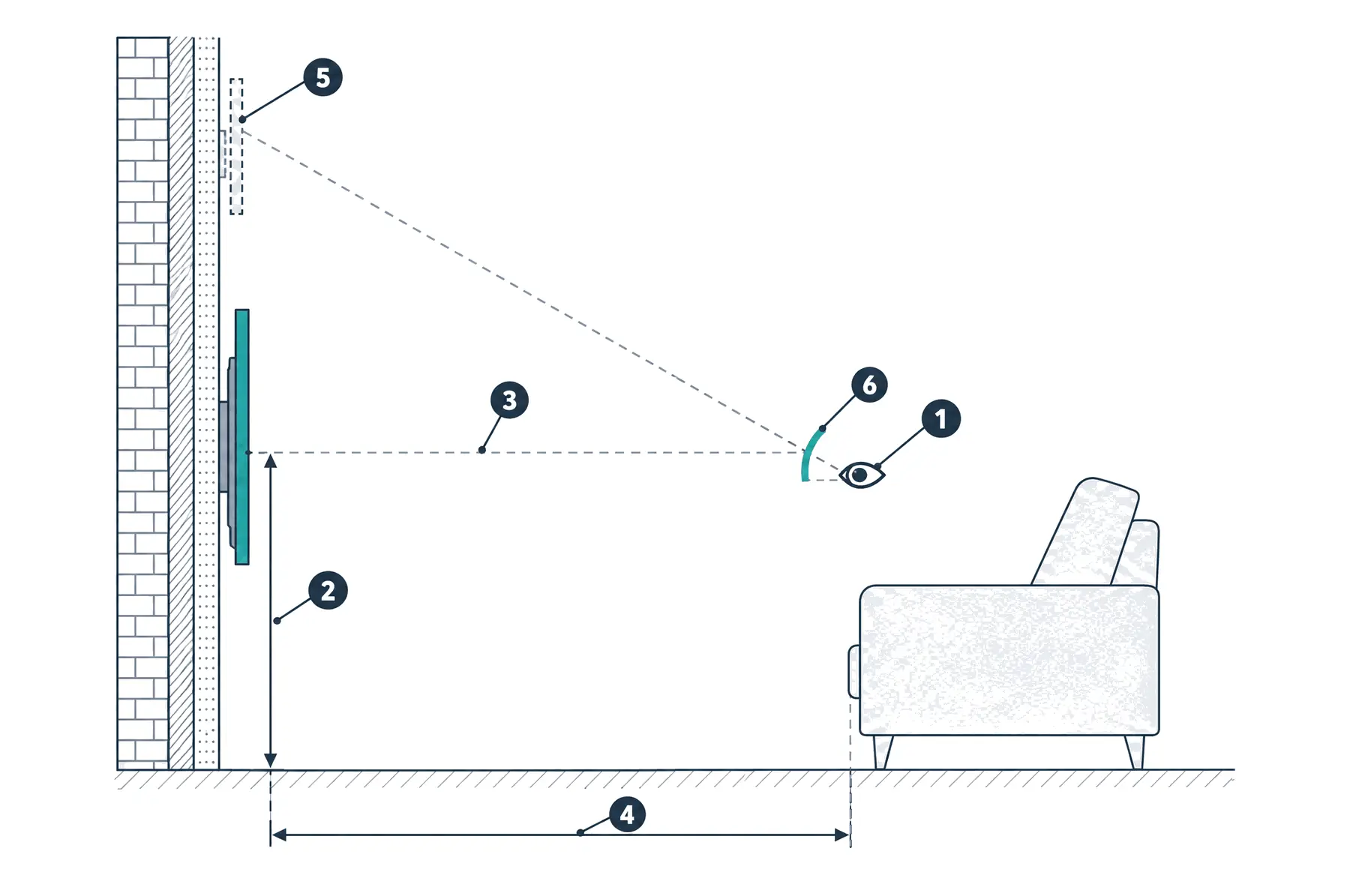
What the numbers show
- Seated eye height On most sofas a seated adult's eyes are roughly 40 to 42 inches above the floor; the screen height is planned from there, not from the wall.
- Height to screen centre For seated viewing the screen centre usually lands about 42 to 48 inches from the floor, adjusted to the sofa and the TV size.
- Level sight line A level line from the eye to the screen centre means the neck stays relaxed for a whole film.
- Seating distance The distance from the seats to the wall, together with the screen size, decides how large the TV should be and how high it can go.
- A TV mounted higher Above a tall console or a fireplace the screen ends up well above the eye line.
- Upward viewing angle The steeper this angle, the more a tilting or pull-down mount helps bring the picture back toward the viewer.
Fixed or tilting for the room
- Fixed low-profile — sits 1–2 inches off the wall; the cleanest look where the screen faces the seating at eye level.
- Tilting — angles 5–15° down; for bedroom walls, higher placements and rooms where afternoon light from a slider hits the screen.
- Extended tilt — a tilting mount with extra depth to clear a recessed media box or thick baseboard trim.
A TV that hangs level and at the right height disappears into the room; one that is two inches off does not.
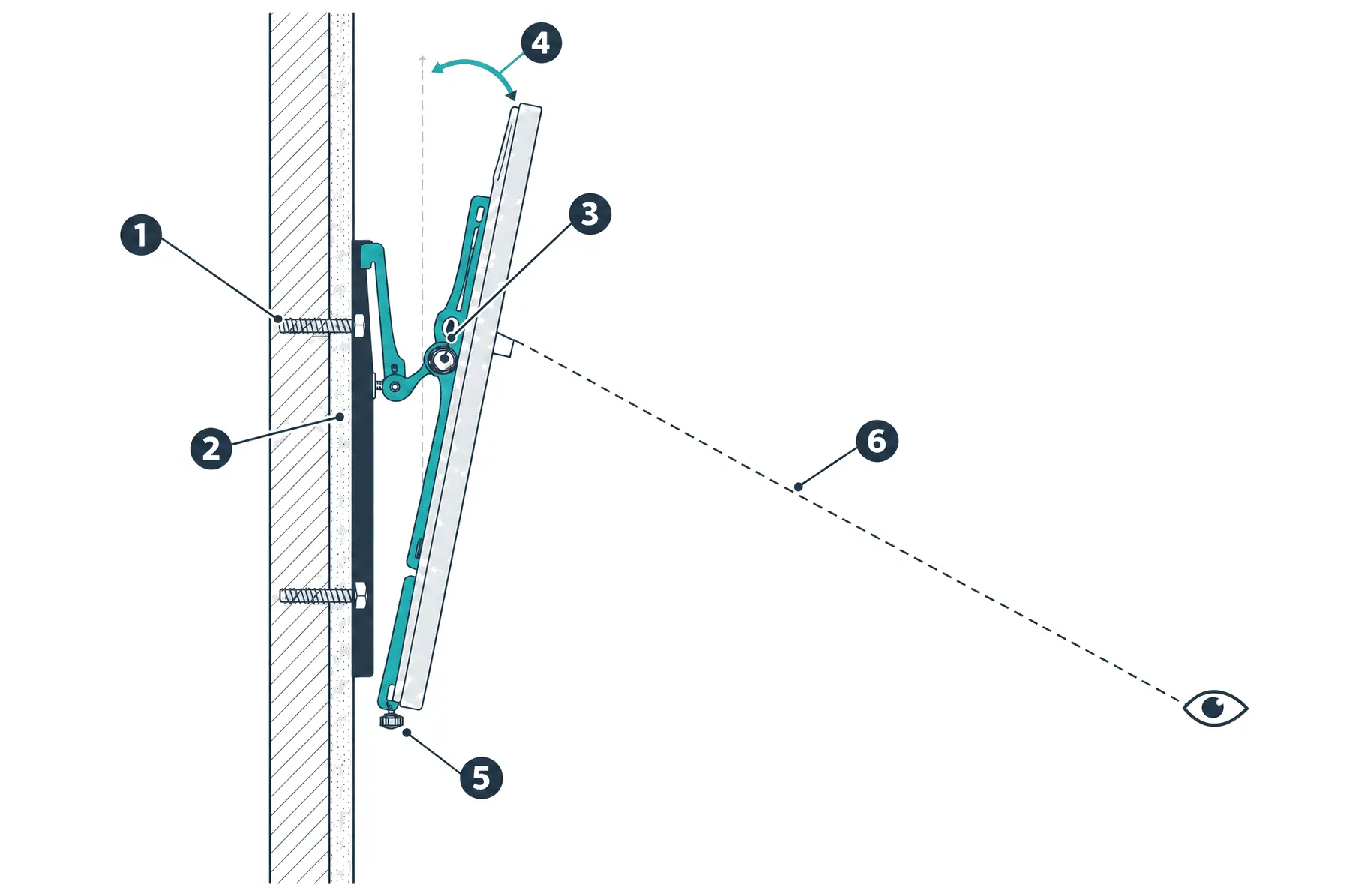
What the numbers show
- Lag bolts into the stud The plate is fastened with lag bolts through the drywall into the centre of the wood stud, heads on the plate side, so the load goes into the framing.
- Wall plate A flat steel plate fixed level on the wall; the brackets on the back of the TV hook over its top rail.
- Tilt hinge The brackets bolted to the TV's VESA holes pivot here. Most tilting mounts let the screen lean forward by roughly 5 to 15 degrees.
- Tilt angle Leaning the top out turns the screen down toward the seats and moves window reflections off the picture.
- Locking screw A screw at the bottom of each bracket locks the TV onto the plate so it cannot be lifted off by accident.
- Sight line The picture looks best when the line from a seated viewer's eye meets the centre of the screen at about a right angle.
Finishing the install
After the TV hooks onto the plate, the installer checks level again with the screen's weight on it, sets the safety screws or locks on the mount arms, and routes the cables to the outlet with ties or a short cover. Dust from drilling is vacuumed as it comes. The mount's instructions and the leftover hardware stay with the homeowner.
TV Wall Mounting — common questions
How much does basic TV wall mounting cost in Irvine?
About $119–$149 for a 32–49 inch TV and $139–$179 for 50–65 inches on wood-stud drywall in 2026; larger TVs, steel studs and other walls add to that.
How long does a standard mount take?
Usually under an hour for one TV on a wood-stud wall, a little longer on steel studs.
TV Wall Mounting: check availability and price range
Bookings aren't open yet — describe the TV and the wall and get a typical Irvine price range right here. Typical Irvine prices for one TV, labor only unless an option says otherwise. This is a market estimate, not a quote.