
TV Mounting Studio Irvine: Condo and Townhome TV Mounting in Irvine
TV Mounting Studio Irvine covers TV mounting in Irvine's condos and townhomes — the podium buildings around the Spectrum and Jamboree, the attached homes of Westpark, Quail Hill and Portola Springs, and the townhome rows of Woodbridge — where steel studs, shared walls and HOA rules shape where and how a TV goes up.
Bookings aren't open yet. Leave your name and number; your message is recorded, and you'll get one message when a local installer is available.
 Illustration
What makes condo walls different
Many Irvine condo buildings are framed with light-gauge steel studs instead of wood, and units share walls that are built as fire-separation assemblies between neighbors. Townhomes usually have wood framing but share at least one party wall. Both affect the install.
| Building type | Common framing | What changes |
|---|---|---|
| Podium condo building | Steel studs over a concrete podium | Toggles or a backer plate instead of lag bolts |
| Garden-style condos | Wood or steel studs | Stud type confirmed on site |
| Attached townhome | Wood studs, one or two party walls | TV placed on an interior partition where possible |
| Stacked flats | Wood or steel; neighbors above and below | Quiet-hours and noise rules apply |
What the numbers show
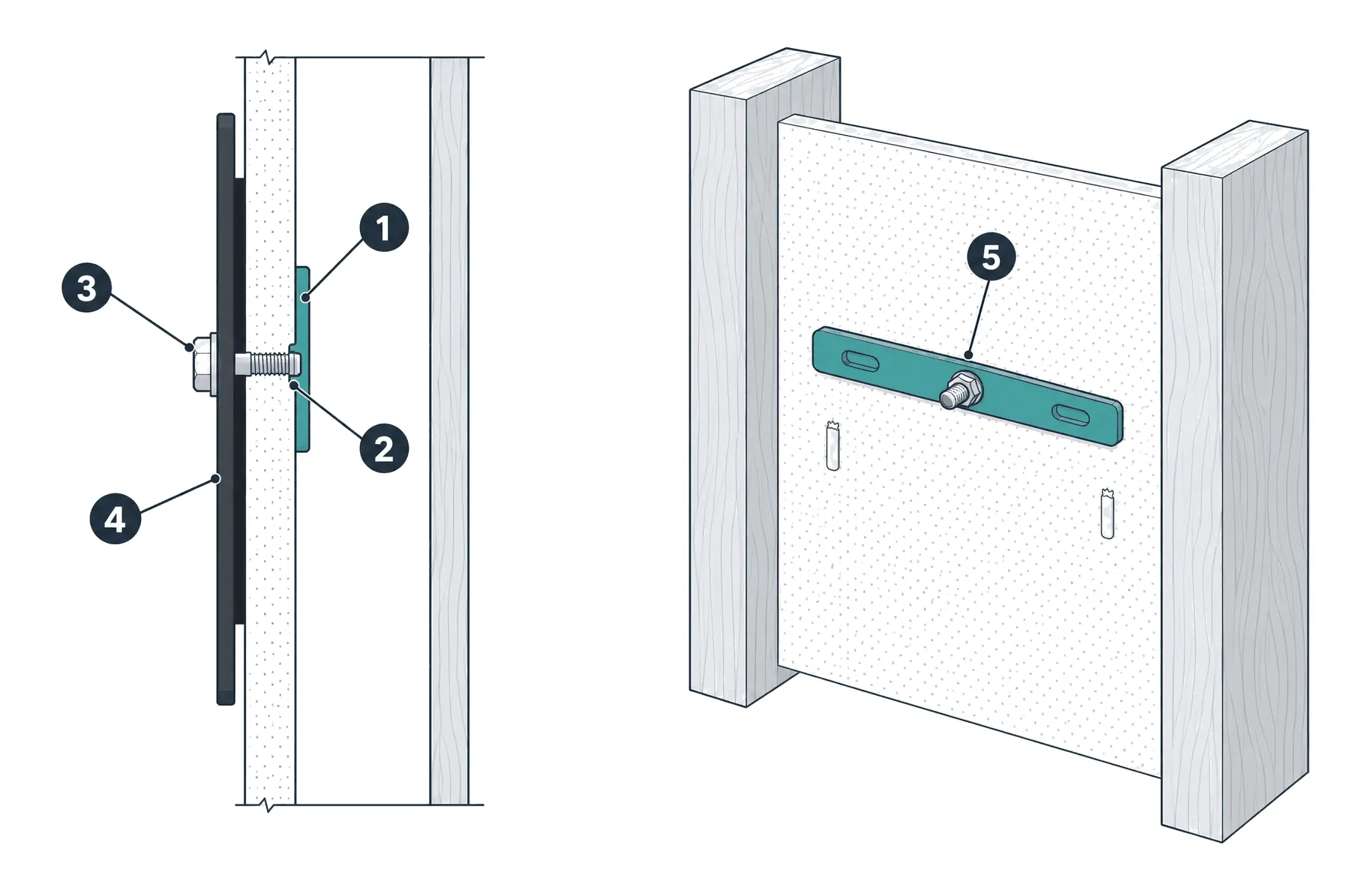
- Toggle channel A flat steel channel is pushed through the hole, turned sideways and pulled tight against the back of the drywall.
- Drilled hole The hole is only slightly wider than the folded channel, so once the channel turns it cannot pull back through.
- Bolt A machine bolt passes through the wall plate and threads into the channel; tightening it clamps plate, drywall and channel together.
- Wall plate The TV's wall plate sits flat on the drywall, and several toggles share the load, each within its rated capacity.
- Load spread across the board Because the channel bears on a wide strip of drywall it holds far more than a plastic plug. The TV's weight is still checked against the anchor's drywall rating, and studs are used wherever they line up.
Shared walls and the HOA
Shared party walls separate units for fire and sound. Driving long fasteners into them or cutting in-wall boxes through them is avoided; many association rules prohibit penetrations into shared walls altogether. When the only good viewing wall is the shared one, the usual answers are a surface mount with short fasteners where the rules allow, a floor-standing TV mount, or moving the seating to face an interior wall.
Noise, hours and building access
- Quiet hours set by the HOA limit drilling to daytime windows in many buildings.
- Parking and loading for a large TV box may need a visitor spot or the loading zone.
- Elevators in podium buildings are sometimes reserved for moves; a TV box usually fits a normal ride.
- Hallway protection for large boxes is considerate in carpeted corridors.
Hiding wires without opening a shared wall
In-wall concealment is possible on an interior partition with an in-wall rated power and HDMI kit. On a shared wall, a slim paintable raceway or a floor-to-mount cord cover painted to the wall keeps cables tidy without a penetration through the separation wall.
A condo TV install is as much about the wall the TV does not go on as the one it does.
Condo & Townhome TV Mounting — common questions
How much does TV mounting cost in an Irvine condo?
About $144–$194 for a 32–49 inch TV and $164–$224 for 50–65 inches on steel studs in 2026 — the base range plus $25–$45 for steel. Larger TVs and in-wall wiring add to that.
Does the HOA need to approve a wall-mounted TV?
Many associations do not require approval for interior mounting but do restrict shared-wall penetrations and set quiet hours. The governing documents say what applies.
Condo & Townhome TV Mounting: check availability and price range
Bookings aren't open yet — describe the TV and the wall and get a typical Irvine price range right here. Typical Irvine prices for one TV, labor only unless an option says otherwise. This is a market estimate, not a quote.